Saturday, June 20, 2015

What's The Deal With Chambers Bay?

The 2015 U.S. Open has just concluded and I keep hearing the same questions and comments. "What's the deal with Chambers Bay? It looks terrible. Is the grass dead? What's up with the greens?"

Let me start by saying that what we saw on tv is most likely not representative of normal conditions at Chambers Bay. The USGA dictates what they want for course conditions including mowing heights, green speeds, course firmness, etc. The USGA strives to provide the toughest stage for the world's best golfers to compete. At Chambers Bay they must have decided that a very firm and fast golf course was the way to go. Chambers Bay is built on a hill of sand which means it dries quickly. The USGA most likely dictated that irrigation be applied at a minimum to speed up the golf course, even if it resulted in wilted turf. What we saw was beyond wilt. Much of that grass was drought stressed to the point of dormancy. While it appeared dead, most of the turf should come back once it receives adequate moisture. 


   Chambers Bay looking green. (Maybe a little photoshop but the turf looks lush)

Now the greens... those poor greens. While tv never does the undulations justice, those were some undulating greens. I would guess that they were designed to roll between 8' to 9' on a Stimp Meter in order to be fair. However, they were at 11'+ this past week. The normal mowing height for those greens is 0.25". (That's unfathomable to me. Due to their density, if I mowed Isla's greens at .25" they would roll about 5' on the Stimp Meter!) For the U.S. Open they were cutting the greens at 0.180". When you think about reducing the height to 70% of normal added with starving them for water and nutrients you are going to have thin turf. When you have areas of thin turf you get bumpiness. These greens were not only fescue but they had some Poa annua which had managed to find its way to Chambers Bay. Throw in the Poa annua and you get even more bumpiness. 

   Ian Poulter posted this photo of a green. Notice wilted blades of 
   grass in all the thin areas. Proper maintenance practices for these 
   greens would help improve their playability.

I'm not going to discuss layout because golf course design is like art, subjective and open to interpretation. However, under normal conditions I would bet that Chambers Bay is a difficult but fair place to play. I would also believe that the fairways aren't "dead" and the greens much better when maintained in their intended form. It caused me pain everytime I heard how awful the golf course conditions were because I know there are some talented and dedicated people who care for that facility the same way my staff and I care for Isla. I bet that we would have seen different golf course conditions this past week if the management was left to the Chambers Bay Director of Grounds and Superintendent. 


Saturday, May 30, 2015

What is the Significance of 9,408,960?

What is the significance of 9,408,960? That is the approximate total number of holes punched into the greens this week. 

   Closeup of an aerified green

Yes, this week was the first of 2 aerifications of the summer. Aerification is one of the necessary evils required to maintain a quality golf course. Aerification serves multiple purposes but primarily it is done to remove organic matter (thatch) and relieve compaction. As a result, playing conditions are improved and the grass is healthier throughout the year. Greens, tees, aprons and other select areas were aerified.

Fairways were verticut this week which is conducted to remove thatch. The end result, once again, healthier grass and better playability. This year verticutting became a much bigger project since we expanded our fairway cut from 20 acres to 55! The amount of thatch material removed is remarkable. 

   Clippings from #1 Fairway

During the verticutting process, we store the clippings on nearby cartpaths for removal later. This is done to keep the verticutting efficiency at it's best. We then come around with a tractor and trailer to remove the clippings from the golf course. Our intention was to finish hauling Saturday morning but the trailer had a hose break. Unfortunately, we won't be able to remove the remaining clippings until Monday after parts are received to repair the trailer. Sorry for the inconvenience. May I suggest holding your nose as you pass by the few remaining piles?

As done in years past we used the aerification plugs from the greens to renovate or construct select tees. Much of the time these tees are the forward tees used for both red and gold play. Originally, these tees were constructed to accommodate a small amount of play. Golf's demographics have changed greatly over the past 35+ years bringing many more women to the game. Plus the addition of gold tees has concentrated a great deal of play from some very small tees. This doesn't allow much room for rotation of teeing area and results in wear. We have focused the past couple of years on improving these tees. This past week we expanded the red/gold tees on 3 and 14. We also added more square footage to the red tee on 9 and built a brand new gold tee on 18.

   Aerification plugs after removal from green

   #3 forward tee. Left side is original tee. Right side has been newly constructed with soil.

   Topdresser used to spread plugs evenly on green

As you can see the hard working men in grounds maintenance accomplished a lot in the 4-day Memorial Day week. However, the work from the past week is not yet complete. Most of the "destructive" practices have concluded but we will still be working on recovery, clean-up and other cultural practices such as topdressing to ensure a good and speedy recovery. 

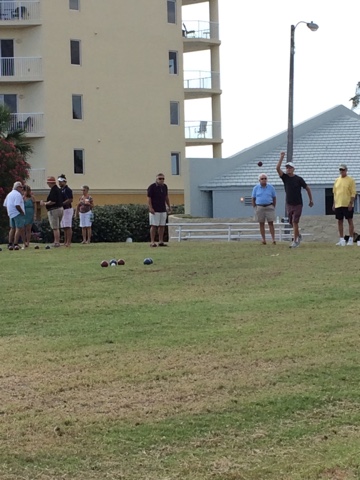
   Aerification certainly didn't dampen the spirits of the Friday Bocce players!


Thursday, May 21, 2015

What Are Those Lines?

If you have played golf recently you may have noticed some bright pink markings painted on 9, 10 and 18 fairways. These lines are marking underground utilities currently running under the golf course. Contractors for Duke Energy will be pulling new powerlines underground from the Bayway over to Casa Del Mar. Not to worry, we have been told the contractors should not need to excavate or disrupt the golf course. 


Wednesday, April 22, 2015

Time For A Haircut

This week the grounds maintenance department started cutting back the ficus hedge that separates the golf course from the Bayway. As the hedge grows over time the bottom branches start to thin. Cutting back the ficus encourages the plants to fill in and maintain a thick hedge for separation from the outside traffic. While it may look drastic now it will prove beneficial once it recovers.

Also, please mark your calendars that there will be an 8:00 shotgun on Monday, April 27th. The golf course will be closed that afternoon for fertilization.


Thursday, April 16, 2015

National Golf Day 2015 (and Cherry Blossoms!)

I had the opportunity to spend 3 days this week in Washington D.C. where on Monday and Tuesday I participated in the Golf Course Superintendents Association of America (GCSAA) Government Relations Committee meeting. I have the privilege to be 1 of 10 superintendents from around the country who serve on this committee. During the meeting we discussed priority Government Relations issues affecting the golf industry. Some of these issues included the proposed Waters of the United States (WOTUS), pesticide and fertilizer regulations, water quality and quantity, the H2B visa program, ADA accessibility and the past exclusion of golf from disaster relief funds. 

Tuesday we had the opportunity to meet with the offices of Senator David Vitter (R-LA), Senator Jerry Moran (R-KS) and Senator Pat Roberts (R-KS). These Senators all chair committees important to the GCSAA Government Relations Committee agenda. 

   GCSAA Government Relations Committee with Senator Pat Roberts (R-KS)

On Wednesday, the Government Relations Committee and the GCSAA Board of Directors participated in National Golf Day, which is organized by WE ARE GOLF. GCSAA, along with the Club Managers Association of America, the National Golf Course Owners Association, the PGA of America and the World Golf Foundation are founding members of WE ARE GOLF. On National Golf Day participants divided and conquered "The Hill" meeting with many Senators, Representatives and their offices to discuss the benefits of golf and ask for help on golf related issues. I was privileged to have meetings with the offices of Senator Bill Nelson (D-FL), Senator Marco Rubio (R-FL), Rep. David Jolly (R-FL-13th), Rep. Vern Buchanan (R-FL-16th), and Rep. Mario Diaz-Balart (R-FL-25th). 

   Myself with Rep. David Jolly (R-FL-13th) and Winter the Dolphin 

Founded in 2009, WE ARE GOLF was formed in part because it was evident the industry was misunderstood by too many elected officials. Perceptions of the game simply did not coincide with reality. By focusing on the nearly two million Americans whose livelihoods are tied to golf, WE ARE GOLF has leveled the playing field for the thousands of small businesses that make up the industry. As a result, golf is no longer being excluded from important legislation and our elected officials have a better understanding of the myriad of benefits the game brings to their communities.
 
The nearly two million U.S. jobs generated by the nearly $69 billion golf industry, and its vast economic reach are at the core of WE ARE GOLF’S message. In addition to better demonstrating golf’s profound economic clout, WE ARE GOLF illustrates the industry’s health and wellness benefits, its unparalleled charitable giving, and its environmental sustainability initiatives.

We were also fortunate to be in Washington D.C. At the perfect time for cherry blossoms!


Monday, April 6, 2015

Fence Removal

Last week the grounds department started removal of the old fence and hibiscus hedge along the cartpath on #18. The old fence and hedge were originally installed to provide separation between the driving range and #18. Two years ago we planted a row of bamboo which will provide us the same separation but at an even higher height. Most of the bamboo has reached a size and density that the old fence and hedge are no longer needed. They are being removed to provide more space and sunlight for the bamboo. We will be able to widen the cartpath making it easier for carts to pass when heading to #10 tee. Finally, a small barrier is planned for the inside of the driving range to keep practice balls from rolling through the bamboo. 

We recognize that the old fence used to serve as Out-Of-Bounds. We are working with Fred Curtis to determine how and where to mark this area and will pass along this information. 


Wednesday, March 18, 2015

Mole Cricket? What The Heck is a Mole Cricket?

My favorite time to be on the golf course is just before sunset. Things are quiet and peaceful. The low angle of the sun casts long shadows adding a unique perspective not experienced during the middle of the day. It's a great opportunity for reflection.

   #3 Green in the Evening

I spent Monday evening on the grounds at Isla treating for mole crickets. Not a lot of time for reflection on Monday but still enjoyable. What's a mole cricket you ask? The best answer I can give is it's a really nasty insect. My son describes it as the spawn of the devil. Either way, mole crickets are not welcome guests on the golf course. They damage turfgrass through tunneling as well as eating the grass itself. If left untreated, mole crickets will destroy a large area of grass in very little time. Fortunately, we preventatlvely treat for mole crickets each spring which minimizes the damage throughout the year. This time of year we get adult mole crickets that fly in from elsewhere as last year's preventative application wears off. As we scout mole cricket activity, we selectively treat those areas before problems arise. Since mole crickets are primarily active at night we apply our treatments late in the day to increase the effectiveness.

   This is a Mole Cricket

   Early Stages of Mole Cricket Activity

   Long Shadows on #8